Showing posts with label Lab. Show all posts

Friday, November 25, 2022

Christmas Stocking Stuffers For The Scientist In Your Life


Most of these items can be found in dollar stores, department stores, pet stores, etc. They are very inexpensive and are great for fitting into Christmas stockings.


Tools Needed in Your Lab


- Glass medicine droppers, comes with 1 straight and 1 curved tip.

- Clothes pins, they come in all sizes and materials.

- Hard plastic straws.

- Kitchen tongs. The one in the picture, I sprayed a rubber coating   on the handle.


More Lab Items


- Aquarium air stone.

- Aquarium flexible airline tubing.

- Tweezers.

- Lab journals.


This is just a small amount of items that they may want or need. It is always good to have many items on hand. As you walk through these stores just look around, you should be able to find other items they can use.

Have a Merry Christmas!!!

Wednesday, February 10, 2021

Media Pump

Using a Syringe Filter to Sterilize Media:


Syringe and Filter

I picked up some syringe filters from Amazon figuring I could use a syringe to pass my media or water through the filter. As seen in photo the filter screws on to the top of syringe. This filter membrane has a pore size of .22 micrometers. This should easily sterilize the fluids.


Parts


Thinking there must be an easier way to run the media or water through the filter I picked up a 12V DC DIY Peristaltic Liquid Pump from Amazon. As seen in this image as well as the pump I picked up air hose tubing and airline tubing connectors from a pet store. The connectors allows different sized tubing to fit together.


Fitting to hold filter


I had a medical drop administration set I found at a flee market. This has the same type of connection as the syringe tip has, allowing the filter to screw on. As seen in the above image.


Unit put together


In the final image you can see the whole unit put together. I am using a 12 volt wall adapter hooked up to the motor speed controller (previous project) to control the pump motor. The filter holder was made with a 1/4 inch dowel and clothes pin glued together.

I pump the fluids through the system slowly as to hopefully not cause a big mess if it ever backs up. I intend to mount the pump into a weighted box so I don't set it up when I need to use it.


Saturday, September 12, 2020

Laser Projector Microscope

Equipment needed:

Laser pointer(green 532 nm) or red, Syringe(10ml), screen or wall, apparatus to hold laser and syringe in place, sample(from my aquarium).

Green Laser Pointer

 
In the diagram above you can see how the microscope is set up. The laser beam runs through the specimen droplet that is formed below the syringe. This produces an image on a screen on the other side of the droplet.
 
 
Image on Screen


Moving the laser closer and further away will bring the object in focus. Even if not completely clear or bright you can see the organisms swimming around. You can make out some detail to try and identify the organism.


Beam on Droplet


After reading some more on the laser microscope I found that the drop of water acts as a small spherical lens which magnifies the image. I tried the red laser pointer but the image was not as bright. I will look further into this in the future.

Friday, November 8, 2013

Sample Rotator

Parts

Front View

Side View

With very simple items I had laying around I was able to build this sample rotator. It rotates very slowly. This will allow samples to be mixed. I hope to place it in my incubator to attempt to use as a shaker for the media broth for cultures (continual mixing).

Parts: the motor came from an old hand-held vacuum, I bolted a disk from the bottom of a cd holder on to it. The frame is from an old computer power supply box (the top half). I use 1 inch PVC conduit clamps to hold the motor in place. I use broom handle wall clips to hold my culture tubes. They had to be adjusted to fit both 15 ml and 50 ml tubes. They are mounted on the plastic disk with nuts and bolts. It runs using a power supply that ranges from 1.5v - 12 v.

Friday, August 17, 2012

Condenser

Photo 1 - Parts for Condenser

Photo 2 - Inner assembly

Photo 3 - Fully assembled

Photo 4 - Full set-up


Condenser


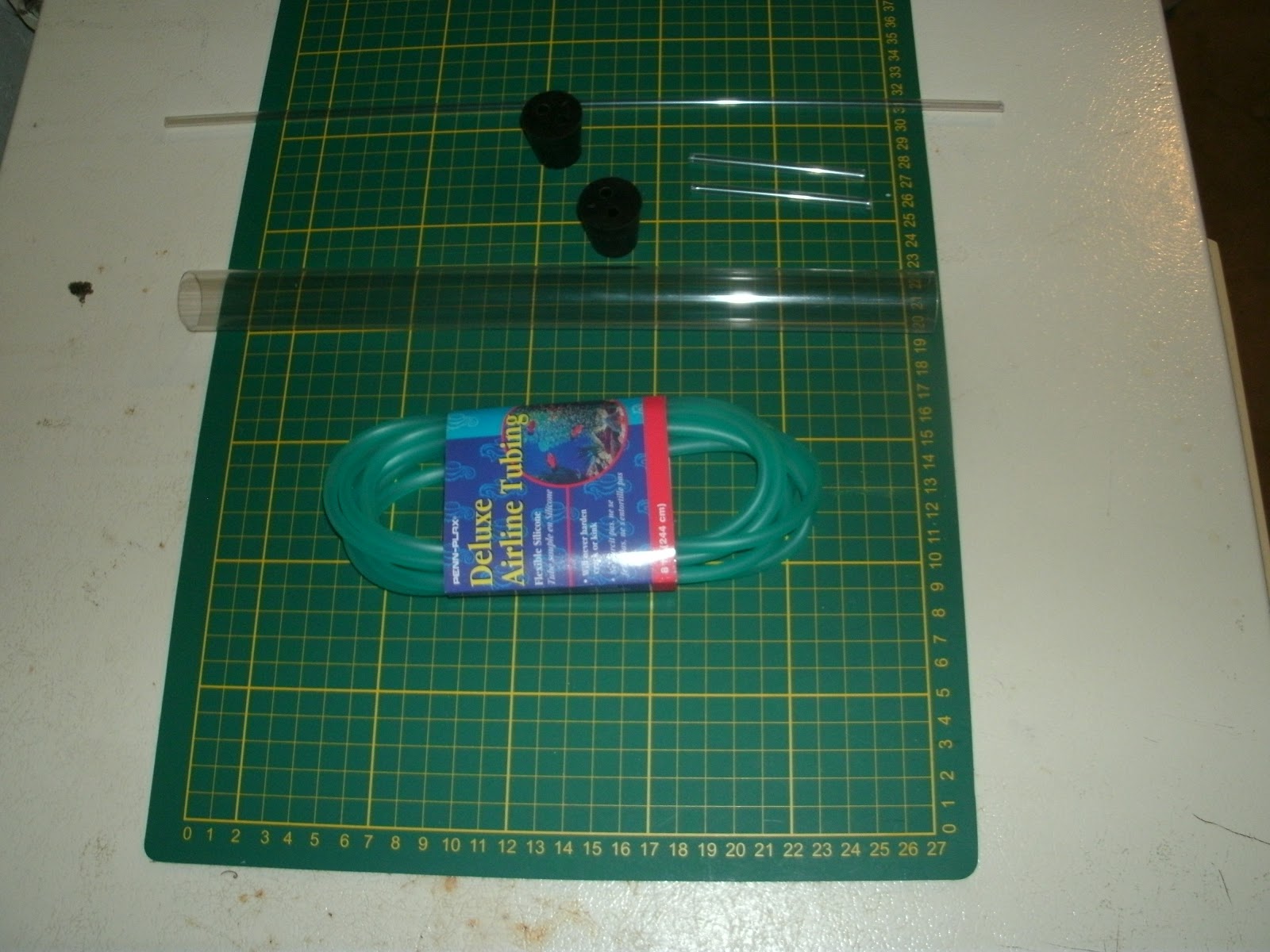
A condenser is used for distilling and separating chemicals in fluids. They can be a very expensive item. In the photos above you can see how I made one from items I found in a pet store - total cost less than $5.00.

Items needed:

1) Outer tube (approx. 12 in. long, 22 mm inside dia.) - Large diameter plastic tube - can any kind of tube clear plastic, white plastic or black plastic tubes. As well as copper or glass tubes.
2) Inner tube(longer than outer tube, 16 in. long, 5 mm outside dia.) - Small diameter plastic tube - can also be glass tubing (I recommend glass f you can get it).
3) Inlet and outlet tubes(2)(3 inches long, 5 mm outside dia.) - Small diameter plastic tube.
4) 2-hole rubber stoppers (2) - They fit tightly into the large diameter tube. No. 4 stoppers fit best for my set-up.
5) Rubber tubing(fits 5 mm outside dia. tubing)  - Used to run water into and out of the condenser. This is air tubing in the aquarium section.

First photo shows you the collected items.

Second photo shows how to assemble the inner tubing.

Third photo shows the condenser put together.

Fourth photo shows the condenser in working mode. Notice the baby fruit jar (I talked about this in the previous post) being used as the flask to be heated and the baby food jar(I talked about this in the previous post) is used for collecting.

Wednesday, November 30, 2011

More Links

More Links

Low Cost Equipment for science and technology education:

http://unesdoc.unesco.org/images/0010/001023/102321eb.pdf

The second part:

http://unesdoc.unesco.org/images/0007/000728/072808eb.pdf

This link has science articles and experiments from the old magazine Modern Mechanix:

http://blog.modernmechanix.com/category/science/chemistry/

You will notice under my links some are no longer there. I have removed any links that are no longer working. Please remember when a new link goes up get the information you need and store it because you don't know how long it will be up.

Sunday, November 6, 2011

The Arduino


The Arduino

I have been looking at the Arduino for some time. I finally picked one up, as well as the first edition of "Getting Started with Arduino" by Massimo Banzi. This seems to be a simple and inexpensive way to learn and to use a micro controller. A way to connect different sensors to a computer. Just great for the home lab. It is an open source electronics prototyping platform. You can purchase one already built or you can get the parts and put it together yourself. The Arduino receives input from a variety of sensors, which can then control lights, motors, and other actuators.

There are many books on the arduino. I have just the one, "Getting Started with Arduino" by Massimo Banzi.

I will post arduino lab projects as I build them. I am looking into a spectrometer, digital thermometer, pH meter, etc. So stay tuned. But for the time being look at these websites, become familiar with the arduino and enjoy.

The home page for the Arduino can be found here:

www.arduino.cc

and the Getting Started with Arduino page is:

arduino.cc/en/Guide/HomePage

Another Beginners Arduino Tutorial can be found here:

www.ladyada.net/learn/arduino/

A project site:

www.practicalarduino.com/projects

Tuesday, June 14, 2011

More Links


Here I give you some more links to look at. Some you will find very important to the Citizen Scientist, where to find chemicals and even more importantly chemicals that are incompatible with each other.

1) This link has a very extensive list of commonly available chemicals and where you can find them:

http://en.wikipedia.org/wiki/List_of_commonly_available_chemicals

2) From the Ohio State University College of Biological Sciences this link gives you a list chemicals that are incompatible. I recommend printing this out and keeping it on a wall in your lab for future reference.

Incompatible Chemicals: http://www.biosci.ohio-state.edu/safety/safety/IncompatibleChemicals.htm

3) I believe that this maybe from the old Modern Mechanix magazine. It shows you how to make a distillation system, a ring stand, etc. Enjoy I did.

Equiping Your Chemical Lab: http://www.vintageprojects.com/science/chem-lab.pdf

4) This is a very large file and takes awhile to load. Every Citizen Scientist should have this and look through it. I even have it printed out, all 900 and so pages. It shows very simple items to build and up to larger more complicated lab equipment. This is the same book I have talked about before ( see link on my blog: This site no longer worksConstructing Inexpensive Lab Equipment) and that link is dead. This is all the pdf files put into one large file. So go and get it now while it is there.

Guidebook to Constructing Inexpensive Science Teaching Equipment: http://www.howtomakeeverything.com/CD3WD/JF/438/28-720.pdf

Friday, May 27, 2011

More Books


I have picked up a couple of interesting books, a couple of older 1960's books and one a little newer late 1990's:

1) Junior Science Projects - 1967 by the Editors of Science Experimenter:

This book has many experiments you can do and many pieces of equipment that you can build. Such as a milli-microampere detector, ion-exchange fuel cell, diffraction grating-type spectrscope, thermistor thermometer, make your own plastic lab equipment (see picture above) and more. Some of the electronic projects require specific tubes, but I am sure with internet searches you can find other ways to make them. A real interesting read.

2) Exploring Science in your Home Laboratory - 1963 by Richard Harbeck:

This book discusses how to build a home science laboratory for chemistry, biology, physics and geology. It walks you through choosing where to locate the lab, which one you would like to build first. Then helps you set it up, from building a work bench with shelves and then a way to remove the air if you don't have a window in your area. From here it helps you build different lab equipment for your lab, such as a simple electric heater, alcohol lamp, drying and sterilizing oven, test tube racks, stands, beam balance and more. This book must have been a real gem back in it's day.

3) A Low Cost Approach to PCR - 1998 by Eva Harris:

This is a good book for the DIYBIO groups. The low cost approach outlined in this book can be useful for the DIYBIO group. It provides a description of the theoretical basis of the technique and practical details of the method. There is a section on materials and chemicals needed in your lab. A section on building your own equipment ie. electohoresis chamber, micro centrifuge, etc. A section on preparing your reagents. I believe a very useful book for the DIYBIO person.

Monday, December 13, 2010

Future Projects

Future Projects

I have been very busy lately and with Christmas coming I haven't had as much time to play around as I would like. But here is a list of projects I am working on:

1) converting an old fridge, the bottom section I will use it for chemicals storage unit and convert the top freezer compartment into an incubator.

2) build a flask and plate shaker from an old turntable

3) a roller from an old printer (it rotates and mixes solutions in tubes)

4) a new transfer (sterile) chamber

5) video add-on for the microscope

6) a new work area

So stay tuned in the new year and have a Merry Christmas.

Sunday, August 29, 2010

More Of My Lab


More of My Lab

This picture shows more of my lab. Most of my biological work gets done here.

Over the summer I have picked up many discarded items:

VCR's - they have motors that can move things and timers to set things up.
Blenders, slow cookers (maybe able to use for water baths), electric cup warmers (again use for water baths), aquarium and aquarium heaters.

A great book I found a bit out-dated: Recombinant DNA a Short Course by James Watson, John Tooze and David Kurtz. It is a short course on DNA manipulation, so far a very interesting read. I found this at a second hand book store for $1.00.

Another book I have read over the summer was "A Life Decoded" by Craig Venter. It deals with Venter's time dealing with the human genome group, as well as other parts of his life.

If you want plenty to read and watch, go to www.hhmi.org. There is so much there, so much information. You can even download their journal as PDF files. They have interactive labs, etc.